
How can a system’s intent
reach users without being misread?
Reworked the banner copy and information hierarchy of Naver Map’s 'Review Cleansing System', cutting user misreading from 35% to 10% and improving UX
- Role
- Planning
- Period
- 2026.06 – 2026.07
- Type
- Personal reverse-planning project · Naver Map Review Cleansing System · UX improvement and A/B test
- Team
- Planning 1 (me)
Bottom line
- User voice
- Survey of 81
- A/B test
- Success metrics set in advance
Changing only the banner message cut negative misreading from 35% to 10% The system’s intent got across without misreading — no feature changes
- −25%pNegative misreading 35% → 10%
- +30%pCorrect understanding 55% → 85%
- p<.01Statistically significant (two-proportion test)
I noticed a user behavior that looked like simple churn, used user research to sharpen it into the problem of 'the gap between a system’s intent and how users perceive it', and planned a fix that changes only the information structure — no new features — to reduce misreading.
- Intuitive problem spotting
- User research
- Survey of 81
- Problem definition
- Hypothesis
- Solutions
- Requirements
- Action
- Results
- Retrospective
How I spotted the problem
Why do people re-check reviews from Naver Map in another app?
I started from a behavior pattern that many people, including me, show when looking for a restaurant: cross-checking reviews by moving between platforms like Naver Map and KakaoMap.
In the survey, 52 of 81 respondents said they use several apps to explore restaurants. But comparing across apps is a natural behavior of careful users, so treating that churn itself as the problem didn’t hold up.
So each platform has strengths and weaknesses, and people move to another platform to make up for a weakness. I asked: what makes someone move from Naver Map to KakaoMap?
Users are misreading the system’s intent
In the first perception survey (N=81, 2026.07), 26 people (32.1%) read the system the opposite way — as "a system that lets owners delete negative reviews at will, or lets Naver manipulate reviews."
Why I chose this problem
- Cause of distrustPromotional reviews
- DilemmaA trade-off between an 'active' review ecosystem and 'trust'
- Review Cleansing SystemIntroduced to ease the dilemma and manage review trust
- Current stateIts purpose and workings weren’t communicated well, so it backfired — misread as a deletion or manipulation system
- ScopeI can’t change the algorithm or operating policy directly, but how the system is explained at the user touchpoint is within what I can validate
- DirectionSo I chose closing the gap between the system’s intent and users’ reading as the priority
What I found
The survey surfaced 3 findings, and I sharpened the scope of the problem to solve.
| Finding | Evidence | Needed to validate | Decision |
|---|---|---|---|
| Finding 1 | 52/81 (64.2%) re-checked reviews in another app after Naver Map | Internal logs (drop-off points, return) | Excluded — cross-checking is a careful user’s natural exploration |
| Finding 2 | Distrustful users named review events (20/24) and sponsored-trial reviews (22/24) as causes | Policy · operations data, fake-review detection algorithm | Excluded — platform structure · policy, outside what a personal project can validate |
| Finding 3 | 26/81 (32.1%) read the system the opposite way, as "deletion · manipulation" | My own A/B survey | Chosen — misreading → lower trust, directly verifiable |
Potential business impact if left alone
- MisreadingReview Cleansing System is misunderstood
- Lower trustTrust in Naver Map reviews drops
- Lower expectationsInterest in Naver Map reviews falls
- Churn without returnPlace decisions get made on other channels
- Lost opportunitiesSaves · shares · bookings · Naver Pay conversions leak away
Problem definition and hypothesis
Does the Review Cleansing System’s intent get across without misreading the moment users see it?
Improving how the banner delivers its message will raise correct understanding and lower negative misreading about deletion · manipulation
Less misreading, understanding kept
Success means reducing the misreading group’s misreading while keeping the correct-understanding group’s reading intact
I classified first-survey answers by type of reading and set success conditions before testing.
The conditions covered not only reducing negative misreading but also not creating new misreading among those who already understood correctly.
4 groups and target setting
“A system that lets businesses delete negative reviews they don’t like”
- Primary target of this improvement
- Metric to reduce — negative misreading rate
“A system that automatically filters out fake reviews”
- Watch for new misreading
- Metric to keep — correct understanding rate
“Not sure what the system is, never noticed the message”
- Didn’t notice the banner at all
“A system that filters fake reviews and can also delete reviews”
- To observe later
Success metrics set in advance
32.1% (first survey) → target 20% or lower
Keep around 30.9% (first survey) · allowed range within −2%p
Why I chose this solution
I evaluated 6 candidates against
5 criteria (fit, expected impact, development effort, policy risk, verifiability), including fit with the core question ("Does the system’s intent get across without misreading?").
Met Not met
Chosen improvement
- Candidate 1LanguageFamiliar copy for users, supplementing internal jargon used on its own
- Candidate 2Information hierarchyCore meaning at depth 1, details progressively at depth 2
- Expected impactBetter deliveryClosing the gap between the system’s intent and users’ reading
Understood at a glance from the banner
Rewrote the system’s role — buried at depth 2 — as user-facing copy shown right at depth 1
Requirements for the improvement
| ID | Requirement · Acceptance criteria | Priority | Difficulty |
|---|---|---|---|
| REQ-01 | The banner alone must convey the system’s intentThe core meaning is visible right away in the reviews tab, with no extra action | 1 | Low |
| REQ-02 | Provide a user-centered messageClearly state the outcome for users rather than internal system terms | 1 | Mid |
| REQ-03 | Keep the path to detailed informationKeep the 'Details' entry in the banner and its link to the existing detail page | 3 | Mid |
| REQ-04 | Must not create new misreadingExclude wording that suggests who deletes reviews, review manipulation or favoring advertisers | 4 | High |
| REQ-05 | The improvement must be comparableA/B split exposure with every UI element other than the message kept the same | 2 | High |
As Is / To Be
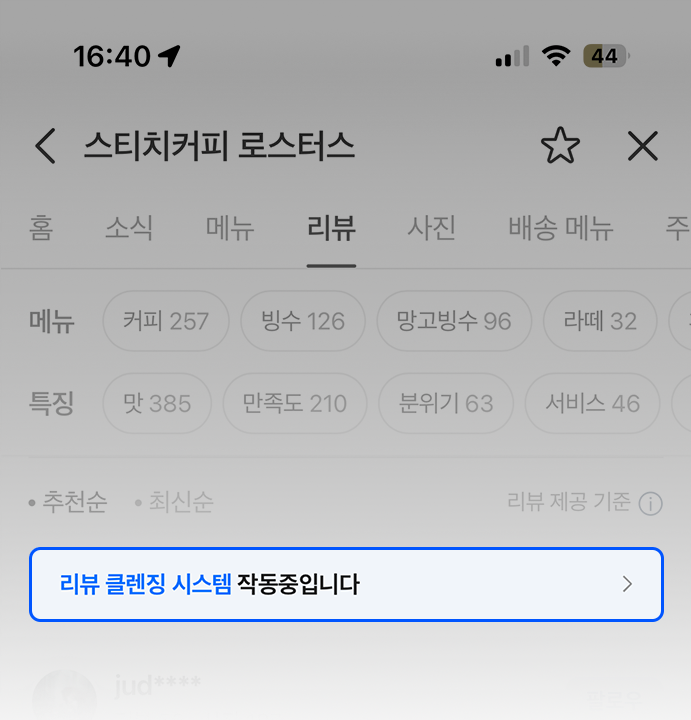
4 steps · users infer the intent and must explore further
- Enter reviews tab
- Notice the system is running
- Tap the entry point (extra step)
- Find the meaning at depth 2
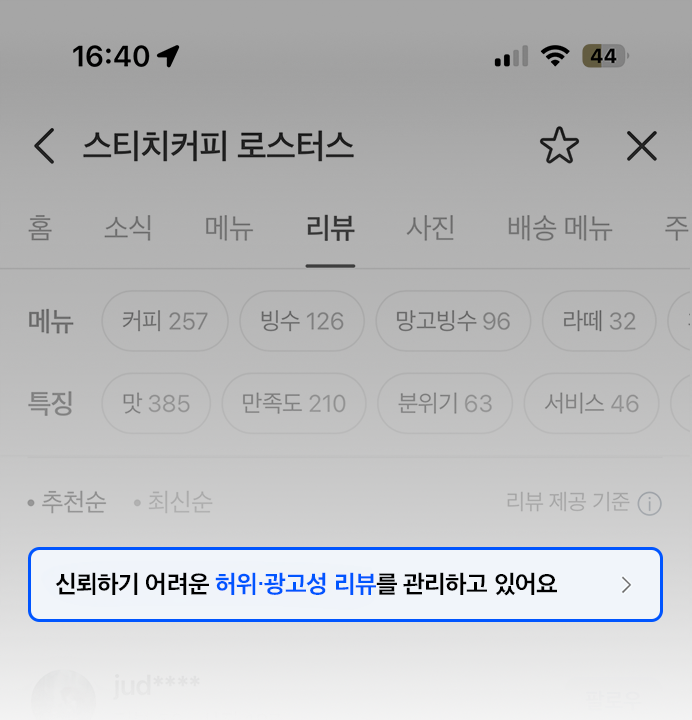
2 steps · understood right from the banner
- Enter reviews tab
- Understand the core meaning at depth 1
Changing the banner message reduced user misreading
Negative misreading down 25%p, correct understanding up 30%p
Second validation survey (N=80) — I split respondents into two groups (n=40 each) and showed the As Is banner and the To Be banner respectively. Every UI condition other than the message was held constant, so any difference in reading came only from the banner message.
Negative misreading 35% → 10% · target of 20% or lower met
Correct understanding 55% → 85% · guardrail exceeded
Statistically significant (two-proportion test)
User perception before and after
- As Is
- To Be
| Group | As Is | To Be |
|---|---|---|
| Negative misreading | 35% | 10% |
| Correct understanding | 55% | 85% |
With the improved banner, negative misreading fell and correct understanding held — supporting the banner-message hypothesis
Propose the improved banner → system intent gets across without misreading → review trust recovers
The As Is figures (35% / 55%) differ from the first perception survey (32.1% / 30.9%) because they come from a separate survey of a separate sample. The targets (20% or lower, −2%p) were set in advance from the first survey, and in the second survey an As Is group under the same conditions served as the direct control.
Learning the value of observation, scope and criteria
- Lesson 01
Don’t jump from an observation straight to a problem
[Before] Re-checking on other channels = churn → [After] Considered that it may be natural exploration. Define the real problem only after checking the context and before/after of an observed behavior.
- Lesson 02
Narrow it to what you can verify
[Before] Naver Map review trust as a whole → [After] The gap between system intent and user reading. Rather than the biggest problem, make it concrete at a unit you can verify yourself.
- Lesson 03
Set criteria before seeing results
[Before] Judging results before testing → [After] Success metrics set in advance. Evaluate objectively against pre-set metrics so the interpretation doesn’t bend to the results.
Project summary
- WHAT · Problem found32.1% negative misreadingSurvey showed 26/81 read the system’s intent the opposite way
- WHY · Problem chosenA problem I could fix directlyFocused on the user-facing message rather than the algorithm
- HOW · Design · executionBanner message A/B testCompared reading differences with all UI conditions except the message controlled
- SO WHAT · ValidationTarget met · hypothesis supportedNegative misreading 35% → 10%, correct understanding 55% → 85%